Why Nobody Opens Your Responsible Gaming Tools
Every licensed online casino ships the same set of player controls. Deposit limits, reality checks, time outs, self-exclusion. They pass audit, they sit in the terms, and hardly anyone opens them.
The Gambling Commission put numbers on it. In a survey of 2,007 people in Great Britain who had gambled online in the previous four weeks, use in the last 12 months came out at 17 percent for financial limits, 10 percent for a reality check and 5 percent for a time out. Those are the headline features of responsible gambling UX, and in every case more than four players in five had not used them in a year. What makes this worth a design audit rather than a shrug is that it reproduces. Different operators, different markets, different platforms, teams that have never seen each other's code, same result. A pattern that stable is usually built, not stumbled into. This is a piece about interface decisions, not about ethics and not about law. The legal question is already settled: if you hold a licence, these screens exist in your product. The open question is whether anyone reaches them, and that question never appears in a compliance review, because a compliance review asks whether the screen exists.
Six patterns that keep the feature closed
The limit lives in account settings
Deposit limits usually sit under Account, then Settings, then a responsible gambling sub-page, three or four taps from the game. This reads as neutral because settings is where settings go and every other preference lives there too. The effect is that the control is available to a player already hunting for it and invisible to everyone else.
The section is named in legal language
"Responsible Gambling", "Player Protection", sometimes "Self-Assessment". The naming is neutral because it matches the licence text and the regulator's vocabulary, which is exactly what an auditor wants to see. To a player, the label describes a category of person rather than a category of feature. Opening it means answering a question about yourself that you did not ask.
The player cannot see their own session
The operator knows deposits, withdrawals, net position and elapsed time. The player sees a balance. This looks neutral because balance is the number products have always shown, and the rest does exist, in history, on another screen, in another format. A balance answers what you can bet next. It does not answer where you are.
The reminder carries no numbers
"You have been playing for 60 minutes." In Great Britain that sentence is not laziness, it is the standard read literally. RTS 13 defines a reality check as a display of time elapsed since the session began, and imposes no requirement that it show money staked, money won or net position. It sets no interval either, leaving the frequency to the player. Where the hour is actually fixed by a rule, it is fixed somewhere else: Germany sets 60 minutes under section 6h(7) of its state treaty. Time elapsed is close to the least decision-relevant fact available. The player who is up and the player who is down get the same sentence.
Between playing and self-exclusion there is a gap
In practice the two visible controls are keep going and close the account for six months. British operators are in fact required to offer a time out of 24 hours, a week or a month under social responsibility code 3.3.4, and 5 percent of online gamblers used one. So the control exists, is mandatory, and almost nobody finds it. The state a player is in at two in the morning is "I want to stop tonight", and that is the option hardest to see.
Limits are configured at the wrong moment
Usually at registration, inside onboarding, and then never surfaced again. Registration is a reasonable place to put account setup. It is also the moment a player has the least basis for choosing a number. None of this breaks a licence. Each decision was made separately and defensibly, usually by different people in different quarters. Settings is where settings live, the legal name is the name the audit expects, and a short reminder interrupts less than a long one. The combined effect is the only part nobody designed, and it is the part players get.
The direction of friction
Six patterns, one underlying question. For any control in this set, ask which direction the friction runs. Take a deposit limit. Lowering it and raising it are, in most products, the same operation with the same latency: type a number, confirm, done. Nothing in the interface distinguishes the safer move from the riskier one. Regulators worked this out some time ago, and the asymmetry is now written into law in market after market. In Great Britain, RTS 12D requires a limit increase to wait at least 24 hours and then be confirmed by a fresh positive action, while a decrease must be applied immediately. Malta's Player Protection Directive splits the same way: under article 14(7) a more stringent limit takes effect on receipt, under 14(8) a less stringent one waits 24 hours. Sweden sets the delay on an increase at 72 hours at the earliest. Denmark uses 24 hours. The Netherlands applies the same split under article 4.14(3) of its remote gambling decree. Germany runs the longest, a seven-day protective period under section 6c(3) of the 2021 state treaty, against reductions that take effect at once. That is six markets arriving at the same shape. Making the safer direction instant and the riskier direction slow costs an operator almost nothing, and a player notices it the first time they use it. Where it has not been done, it is usually because nobody framed the two operations as different things.
Six decisions
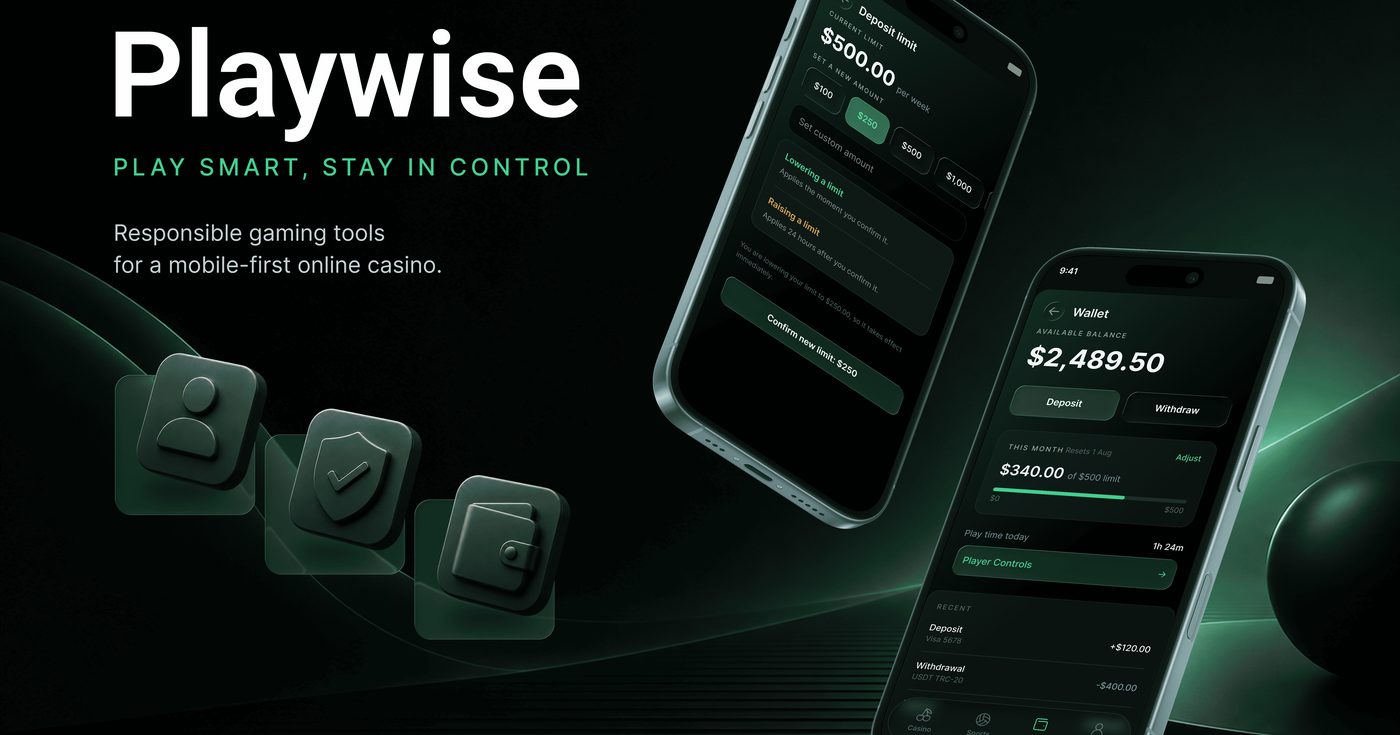
The screens below come from Playwise, a concept that reworks these six problems into a single mobile system. The full case study is here.
Put the control where the money is
The limit lives in the cashier and on the game surface rather than in an account tree. The only moment a ceiling is a live question is when a player is about to add money or has just finished playing.
Name it after what it does
The section is called limits and history, not protection or responsibility. A neutral name is the difference between a setting a player configures and a door a player avoids because walking through it means admitting something about themselves.
Show the session honestly
A session panel carries what the operator already has: time elapsed, deposited, withdrawn, and net position for the session as one signed figure. None of this is new data. Malta already requires that content in the reality check itself under article 18A(2), and Britain requires a running net position during casino sessions under RTS 2E. Putting it in one place the player actually looks at is the work.
Make the reminder carry the data
Same interruption, same frequency, content that can inform a decision instead of restating the clock. On this screen the continue button is the primary action, and that is a decision rather than an oversight. The screen informs, it does not decide for the player. A product that argues with someone every hour gets dismissed on reflex within two sessions, after which the reminder is furniture. The evidence supports modesty here. In the one real-world trial we could find on message content, richer wording roughly doubled the share of sessions that ended, from 0.67 percent to 1.39 percent. Doubling a very small number leaves a small number.
Fill the gap with short breaks
Pauses measured in hours and days, one tap, no support conversation attached. Germany mandates the strongest version of this: section 6i of the state treaty requires a clearly marked button, permanently visible wherever play happens, that triggers an immediate 24-hour suspension. Most people who want to stop want to stop tonight.
Ask when the answer exists
The limit prompt appears after the first deposit and after unusually long sessions, not only during registration. This is the one place with clean experimental evidence. In a randomised trial with 4,328 online slot players at Paf, 45.0 percent set a voluntary limit when prompted at registration, 38.8 percent immediately before the first deposit and 21.9 percent after it, against 6.5 percent with no prompt at all. The shape of the input matters as much as the timing. In a randomised field trial the Behavioural Insights Team ran with bet365, players shown only a free-text box set limits 46 percent lower than players shown the operator's standard dropdown of suggested amounts. One caveat worth stating plainly, because the same Paf trial reports it: prompting lifted the share of players who set a limit and did not significantly change how much they went on to lose. Better design reliably gets the tool used. Whether that changes outcomes is a separate question with thinner evidence behind it.
Why this is a product argument, not a moral one
The objection is predictable and fair: none of this looks like it helps revenue. Worth separating two things that usually get merged. The requirement is not optional. You are already paying to build, test and audit these screens. The only variable is whether the money buys a feature that works or a feature that passes. The cost is the same either way, which is what makes this an unusually cheap thing to fix. Regulators have also moved from checking that tools exist to testing whether they work. In November 2025 the Gambling Commission fined Videoslots £650,000 after its automatic monthly deposit limits "were found to be ineffective when tested in practice", because the limit ran across a calendar month and excluded the first deposit. NetBet paid £650,000 the same month over limits that let one customer deposit £31,000 in two days and exhaust a monthly cap in 40 minutes. Both products had the feature. Neither had a working one. The tick-box version is now specifically expensive. Spreadex paid £2,022,000 in May 2025 after its response to a customer who hit a £3,340 daily deposit limit twelve times in fourteen days amounted to "four pop-up messages" and no human contact. In Ontario, theScore drew CAD $105,000 in penalties in October 2025 for relying on a player's self-assessments instead of acting. In June 2026 Betfred's online licensee paid £900,000 over a review process that would not re-flag a player for seven days, during which one customer lost £17,900 in a day. Malta went looking directly. Its February 2026 thematic review mystery-shopped 20 licensees across 58 URLs and found four that failed to prompt for limits at registration or first deposit, and six whose reality check was missing information the directive requires. There is also a plain commercial reading. A player with a working ceiling does not empty an account in one evening and disappear, which is an argument about how long a customer lasts rather than an argument about virtue. The budget helps too, because it already sits in compliance, the line item that survives cuts longest. And these screens are few, isolated and rarely coupled to anything else, so the work is closer to a sprint than a roadmap item. We design these flows for iGaming and casino operators, and scoping them usually takes less time than scoping a new lobby.
A checklist for your own product
Ten questions a product manager can answer in twenty minutes with their own app open.
1. How many taps from an active game to the deposit limit screen?
2. What is that section called, and would a player who is not worried about themselves open it?
3. Can a player see net position for the current session without leaving the game?
4. Does the time reminder contain any number other than the time?
5. What is the shortest break a player can take, and how many taps does it cost?
6. When a player lowers a limit, when does it take effect? When they raise it, when does it take effect? Are those answers different?
7. Is the limit prompt shown anywhere other than registration?
8. A player decides at 2am to stop for the night. Which control do they use?
9. Can a player find their deposit total for the last 30 days in under a minute?
10. Who owns these screens, and when were they last changed? Most teams find the answers are worse than expected, and that seven of the ten are fixable without touching anything else.
One question
These screens are already in your product, already built, already paid for, already audited. The only open question is whether they work. Worth putting on the agenda at your next product review: which of these has anyone on the team actually opened this quarter? If you want a second pair of eyes on the answer, our work is here.
Sources
1. Gambling Commission, "Exploring consumer journeys using customer-led tools", November 29, 2023
2. Gambling Commission, "RTS 12 - Financial limits", October 31, 2025
3. Gambling Commission, "RTS 13 - Time requirements and reality checks", January 21, 2025
4. Gambling Commission, "RTS 2 - Displaying transactions", January 21, 2025
5. Gambling Commission, "LCCP Condition 3.3.4 - Remote time-out facility", 2026
6. Malta Gaming Authority, "Directive 2 of 2018 - Player Protection Directive (V3)", January 12, 2023
7. Malta Gaming Authority, "Player Protection: Thematic Review, Self-Exclusion Practices in the Online Gaming Sector", February 17, 2026
8. Gambling Commission, "£650,000 fine for online operator Videoslots Limited", November 20, 2025
9. Gambling Commission, "NetBet Enterprises Limited Public Statement", November 5, 2025
10. Gambling Commission, "£2m fine for online operator Spreadex Limited", May 15, 2025
11. Gambling Commission, "Petfre (Gibraltar) Limited to pay £900,000 for regulatory failures", June 30, 2026
12. Alcohol and Gaming Commission of Ontario, "AGCO issues $105,000 in penalties to theScore", October 7, 2025
13. Ivanova, Magnusson and Carlbring, "Deposit Limit Prompt in Online Gambling for Reducing Gambling Intensity: A Randomized Controlled Trial", Frontiers in Psychology, March 28, 2019
14. Behavioural Insights Team, "Gamblers reduce their online gambling spending limits by almost half once operator defined options are removed from view", January 20, 2021
15. Auer and Griffiths, "Testing normative and self-appraisal feedback in an online slot-machine pop-up in a real-world setting", Frontiers in Psychology, March 23, 2015
Need a partner who tracks this stuff?
We build for the markets and rails ahead of the curve.
Talk to us